The Copy Desk Before the Copy Desk
Copy desk history shows how print production shaped a distinct editing role, helping readers understand why the newsroom developed a separate point of review.
The common mistake in copy desk history is to treat the desk as a job title waiting to be invented. Its origins are easier to understand through the practical demands of producing a newspaper: manuscripts had to be selected, set in type and assembled into pages. That account is useful, but it needs a caution. Newspaper offices differed, and a tidy universal origin story would be tidier than the evidence allows.
Editing began as part of running a paper
In early newspaper offices, the publisher or editor might solicit material, write or revise it, choose what appeared and oversee production. These responsibilities did not necessarily belong to separate specialists. The word “editor” could refer to responsibility for the paper as a whole, rather than to someone who handled copy after a reporter filed it.
It is tempting to turn that broad description into a fixed timeline: first one person did everything, then newspapers grew, then the copy desk appeared. The safer account is less dramatic. Roles and routines varied by publication, and the surviving evidence does not support one neat sequence for every newsroom. Histories of particular newspapers can establish what happened in a named office; general claims about the whole press need that kind of qualification.
The distinction that matters here is between editorial tasks and a dedicated editorial role. A person could revise writing without holding a specialist post. As papers organised more stages of production, some tasks could become regular enough to be assigned separately. That is a description of a practical tendency, not a claim that every paper followed the same path.
Printing made the hand-off consequential
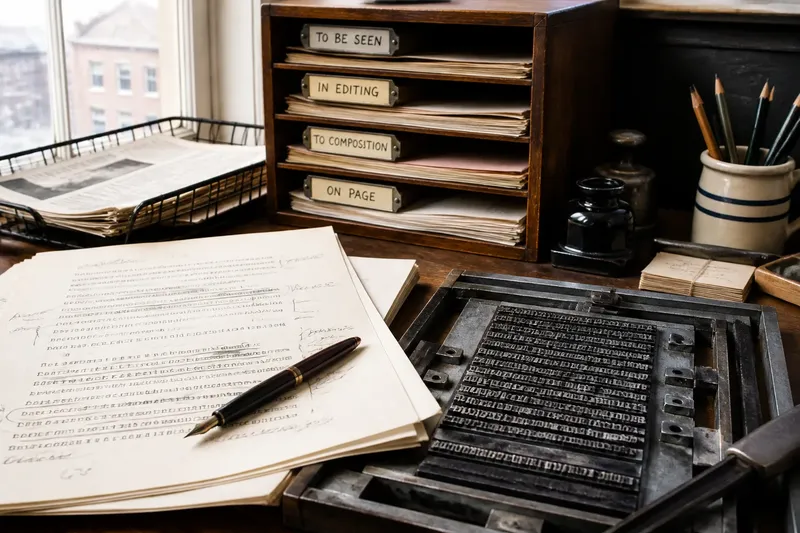
In metal-type production, copy had to be composed into lines and placed in page forms. Changes after composition could require resetting type and adjusting the page. The exact workflow depended on the shop and its equipment, but the basic constraint is plain: a revision made late in production could affect work already completed.
This helps explain why preparation mattered. A manuscript needed to be legible and usable by the people setting type; a page needed to fit the available space. Editing could therefore touch both language and production. It was not merely a matter of correcting a comma, though commas have always been adept at finding work.
Deadlines added another constraint. Once a paper followed a regular schedule, work had to move through the office in an order that let composition and printing proceed. The editor’s decisions mattered partly because they arrived at a particular point in that sequence. A change made before composition was different from one made after the page had been assembled.
A defined route helped offices track copy
Manuscripts could arrive from reporters, correspondents, agencies or other sources. Staff needed to tell which material had been received, which was still being handled and which could go to composition. An identifiable route through the office helped prevent a draft, an unresolved version and a production-ready version from being mistaken for one another.
The means varied. A newsroom might use marked manuscripts, trays, notes or verbal hand-offs; there was no single universal method. What matters historically is the function: staff needed some way to signal the state of a piece and its next destination. A copy desk, where one existed, made that editorial stage more visible and assignable.
This is a narrower claim than saying the desk was created by a particular problem. It treats the desk as one arrangement for organising work, rather than as an inevitable invention. Different offices could divide the same tasks differently, especially when staffing and production demands differed.
Page space brought editorial and mechanical choices together
A story placed on a newspaper page had to occupy a particular space. Editors and production staff might shorten or rearrange copy, set a heading, and consider how the item related to the rest of the page. A headline had two obligations: represent the story accurately and fit the available design. Neither obligation could be ignored without consequences.
Shortening a story could be straightforward when it repeated itself. It was more difficult when a cut removed a qualification or changed the apparent weight of a claim. The craft lay partly in recognising that a line that fitted the space might still distort the account. A page was a physical arrangement, but its choices also shaped what readers understood.
House style made repeated decisions predictable
When several contributors appeared in one paper, spelling, punctuation, abbreviations and presentation could vary. A house style gave staff a shared way to handle recurring choices, such as titles, names and shortened forms. It also meant that routine questions did not have to be settled anew on every page.
Style rules were local working conventions, not universal laws. They could change with the publication’s needs. Their value was practical: a consistent treatment helped staff and readers recognise how the paper presented information. It could not, however, resolve a doubtful claim or repair a muddled account. Uniformity is useful; it is not a substitute for understanding.
What do readers ask about copy desk history?
Was a copy editor originally just a proofreader?
No single job description applied everywhere, but proofreading alone does not capture the range of work associated with preparing copy for production. Revision, shortening, headings and coordination with the next production stage could also be involved. Which duties belonged to a particular person depended on the office.
Did deadlines create the copy desk?
Deadlines help explain why a defined production route could be useful, but they do not establish a single cause or founding moment. Typesetting, page space, staffing and the volume and sources of copy also shaped how offices divided the work.
Did every newspaper have a copy desk?
No. Newspaper offices differed in size, resources and organisation, so the same editorial tasks could be assigned in different ways. The existence of editing work does not by itself prove that a dedicated desk or specialist title existed.
How can a newsroom verify a historical claim?
Start with a specific claim about a named paper, person, date or production practice, then look for contemporary records or a reliable history of that case. Separate what the source documents from any broader interpretation; evidence about one office should not quietly become evidence about all newspapers.
A single page shows why the distinction mattered
Imagine a small newspaper office, with invented details, receiving a local meeting report shortly before its page is due for composition. The manuscript repeats the same background twice, and one sentence leaves unclear whether a proposal was discussed or approved. The editor removes the repeated passage, marks the uncertain sentence for confirmation from the reporter, and leaves the page editor a note that the final length depends on that answer. If the reporter confirms approval, the page can state that directly; if the proposal was only discussed, the wording must say so, and the editor may need to shorten elsewhere. The result is a clear production decision without presenting an unresolved fact as settled.
The example does not establish how every historical office worked. It shows why a newsroom might separate routine preparation from composition: the next person handling a page needed to know what was ready and what still depended on an answer.
Older tools changed, but the historical claim should stay modest
Digital editing has removed the need to reset metal type for every change, but it has not erased the distinction between a working draft and a version ready for publication. That continuity is best described as a similarity of function, not proof that present-day newsroom roles descend in a straight line from one particular nineteenth-century arrangement.
What is not worth the effort is treating every old house convention as a surviving rule of good editing. A convention that no longer serves staff or readers need not be preserved as a souvenir. The useful question is what task it once helped with, and whether that task still exists.
Copy desk history is most persuasive when it stays close to what can be established: newspapers had editorial and production tasks, offices organised them in different ways, and print workflows made timing and hand-offs consequential. For a claim about a particular paper, the next useful step is to name the paper and period, then check a source that documents its practice. That small discipline prevents a plausible general story from dressing up as a universal one.